Offering daily news and analysis from the majestic Evergreen State and beyond, The Advocate is the Northwest Progressive Institute's unconventional perspective on world, national, and local politics.

U.S. Senate’s NRA caucus blocks legislation to require background checks on more gun sales

A bipartisan proposal to require background checks on the sale of firearms at gun shows and over the Internet has failed to advance in the United States Senate after being successfully filibustered by forty-one Republicans and four Democrats.

By a vote of fifty-four to forty-six (with Senate Majority Leader Harry Reid voting nay so that he has the ability to bring up the legislation again later) the Senate nixed the amendment carefully crafted by Senators Joe Manchin of West Virginia and Pat Toomey of Pennsylvania to strengthen background checks, an idea that public opinion research suggests around 90% of the American people support.

Senators from the Pacific Northwest were evenly split on the amendment. The roll call from our region was as follows:

Voting Aye: Democrats Patty Murray and Maria Cantwell (WA), Jeff Merkley and Ron Wyden (OR), Jon Tester (MT)

Voting Nay: Democrats Mark Begich (AK) and Max Baucus (MT); Republicans Mike Crapo and Jim Risch (ID), Lisa Murkowski (AK)

Begich and Baucus were two of the four Democrats who voted against the amendment. The other two Democrats were Mark Pryor of Arkansas and the recently elected Heidi Heitkamp of North Dakota.

As mentioned, Harry Reid also voted against the amendment after he knew what the outcome would be, so that he has the ability to bring it back to the Senate floor at a later point in time. (Reid supports background checks and would have voted aye if there had been fifty-nine other aye votes).

Several Republicans joined with the rest of the Senate Democratic caucus in support of the amendment. They were Pat Toomey of Pennsylvania, Mark Kirk of Illinois, Susan Collins of Maine, and surprisingly, John McCain of Arizona.

McCain’s Arizona seatmate Jeff Flake, who the White House and activists had previously hoped might vote in favor of the amendment, voted nay after announcing he would join the Republican filibuster last night.

Our friends at the PCCC are launching an ad campaign against the four Democratic senators who failed the people of the United States of America by joining in the Republican filibuster to block the Manchin/Toomey proposal from moving forward.

We at NPI are particularly disappointed in Senators Begich and Baucus for standing with the National Rifle Association (NRA) instead of the vast majority of Americans, including responsible gun owners, who support closing the background check loophole so that criminals can’t avoid scrutiny by buying firearms at gun shows or over the Internet. They had an opportunity to demonstrate political courage and they squandered that opportunity. Shame on them.

White House threatens veto of Mike Rogers’ reincarnated CISPA in its current form

Legislation making its way through the U.S. House of Representatives that could further erode our civil liberties would be vetoed by President Obama were it to reach his desk in its current form, the White House said today.

In a formal statement of administration policy on H.R. 624, more commonly known as the Cyber Intelligence Sharing and Protection Act, or CISPA, the Office of Management and Budget outlined what President Obama wants to see in a cybersecurity bill from Congress and characterized the current version in the House – backed by Representative Mike Rogers – as unacceptable.

The Administration recognizes and appreciates that the House Permanent Select Committee on Intelligence (HPSCI) adopted several amendments to H.R. 624 in an effort to incorporate the Administration’s important substantive concerns. However, the Administration still seeks additional improvements and if the bill, as currently crafted, were presented to the President, his senior advisors would recommend that he veto the bill. The Administration seeks to build upon the continuing dialogue with the HPSCI and stands ready to work with members of Congress to incorporate our core priorities to produce cybersecurity information sharing legislation that addresses these critical issues.

Emphasis is theirs.

Prior to today’s veto threat, the House had been moving towards a vote on this latest incarnation of CISPA, so the statement sent out less than a couple hours ago is very timely and welcome. Our allies in the Internet Defense League have been working hard to stop CISPA in its tracks; the ACLU even created a petition asking the White House to do just what it did today.

CISPA is fatally flawed legislation. Democrats like Adam Schiff and Jan Schakowsky tried to fix some of the bill’s most troublesome provisions in committee but their amendments were rejected. The amendments to the bill that were adopted amount to little more than window dressing. They don’t fix the bill’s problems.

If you haven’t heard of CISPA before (or have heard it mentioned in the news but aren’t familiar with its dangerous provisions), the Electronic Frontier Foundation has a good rundown of it that you ought to read.

It was proposed in the last Congress and even passed the Republican-controlled House, but it didn’t make it out of the Senate.

We urge all readers and supporters to join in the campaign to defeat CISPA, and we ask all of our representatives – Suzan DelBene, Rick Larsen, Jaime Herrera-Beutler, Doc Hastings, Cathy McMorris Rodgers, Derek Kilmer, Jim McDermott, Dave Reichert, Adam Smith, Denny Heck, Suzanne Bonamici, Greg Walden, Earl Blumenauer, Pete DeFazio, Kurt Schrader, Raúl Labrador and Mike Simpson – to vote against CISPA if it comes up for a vote in the House.

At least two killed, dozens wounded in blasts at Boston Marathon finish line

Terrible news out of the Commonwealth of Massachusetts:

Two people were killed and at least 23 people were injured in two explosions that rocked the Boston Marathon steps away from the finish line.

A senior U.S. intelligence official said two more explosive devices were found near the area, and they were being dismantled.

The first blasts happened at about 2:50 p.m. near the intersection of Boylston and Exeter streets. Bloody spectators were carried away from the area, and witnesses said several victims lost limbs.

“People started throwing down the barricade and running over one another. I literally saw the garbage barrel explode, and I ran as fast as I could,” said one runner.

Boston police said two people died, and at least 22 were injured. Many tired and scared runners were seen wandering around the area, desperate to find loved ones.

Boston police said that within the last hour, there was an additional explosion at the JFK Library, but there are no known casualties or injuries from that explosion. Police don’t know if that explosion is related to the first two, but they are treating all the explosions as if they are linked (which makes sense).

Police have so far refused to confirm the number of casualties but the traditional media is reporting that at least two are dead and twenty-eight injured. All those injured have been transported away from the scene.

At this time, we don’t have a lot of solid information about this incident, or who is responsible. But it appears these blasts were an act of terrorism, not an accident, given that there were multiple explosions all in the same vicinity, and all during the afternoon of a public holiday (Patriot’s Day) in Massachusetts, when there are traditionally a lot of people downtown.

Massachusetts Governor Deval Patrick has asked people to go home (or back to their hotel rooms) and avoid congregating in crowds.

The White House says that President Obama has been notified and has directed his administration to provide whatever assistance that Massachusetts needs.

FOR MOREThe Boston Globe is liveblogging the aftermath of the blasts.

EYEWITNESS VIDEO: A person who was near the explosions in Copley Square has uploaded a short clip to YouTube. The clip begins right after the first explosion and shows reaction to the second. The Boston Globe, meanwhile, has graphic footage of both of the explosions. Be warned: It’s not for the faint of heart.

Bad news for the Pacific Northwest: KOMO owner Fisher agrees to sell itself to Sinclair

And just like that, another local institution is gone.

Fisher Communications, one of the last independently-owned media companies in the Pacific Northwest, has decided to sell itself to an out of state, right wing media conglomerate for $373 million, the company announced today.

“After conducting our review of potential strategic alternatives, the Board concluded this all-cash transaction was the best path to maximizing value for shareholders,” said Paul A. Bible, Chairman of Fisher’s Board of Directors, in a statement.

“Sinclair is the largest independent TV broadcaster in the country, and we believe its commitment to the industry — along with its greater scale and sizable resources — will provide our stations, team members and business partners with new opportunities to flourish,” said Colleen B. Brown, Fisher’s President and CEO.

We disagree. Fisher’s decision to sell itself is bad news for our region, bad news for media diversity, and bad news for all who care about good journalism.

Sinclair Broadcast Group is the media conglomerate that made a name for itself (in a bad way) during the 2004 presidential campaign when it became known that it was forcing its local stations to air an anti-John Kerry “documentary” called “Stolen Honor” on the eve of the election. This prompted a fierce backlash and a “Stop Sinclair/Boycott Sinclair” campaign, which took a serious toll on Sinclair’s stock.

(We covered this on The Advocate back in October of 2004).

Though nowhere near as huge as Disney, Viacom, CBS, Comcast’s NBC Universal, or Rupert Murdoch’s News Corporation, it is still a big company – it’s the largest owner of local television stations in the United States. Its portfolio already consists of some eighty-seven stations in nearly fifty media markets.

Lately, Sinclair has been on a buying spree. Only a couple of months ago, it reached an agreement with KIRO7 owner Cox Communications to buy four of their stations. And last year it bought six stations from Newport Television. Prior to that, it bought eight television stations from Freedom Communications in 2011.

A commenter on the blog TVNewsCheck, reacting to the news of Fisher’s sale to Sinclair, asks a good question: Where is Sinclair going to find the money to run all of these stations that it is gobbling up?

We are now seeing a total lack of responsibility in broadcasting: According to a March 12 regulatory filing, Sinclair Broadcast Group had $2.27 billion in debt (as of Dec. 31) and is seeking nearly $1 billion in loans to refinance existing debt and support the recent acquisitions of Barrington Broadcasting Group and certain Cox Media Group stations.

According to Bloomberg, the company is also selling $600 million of bonds to pay down existing debt. In the past two years, Sinclair has spent roughly $1.5 billion… buying Freedom on credit for $385 million, Four Points for $200 million, Newport for $467 million, and, most recently, Barrington for $370 million and four Cox stations for $99 million. It has also been reported that Sinclair is trying to buy Titan Television Broadcast Group and its 12 mid-to-small-market stations. Translation: Sinclair continues to buy television stations with money it doesn’t have. How much cash will Sinclair have to operate and improve these stations they are gobbling up? How does this help preserve the voice of local braodcast? It doesn’t.

Colleen Brown claims that Sinclair’s “greater scale” and “sizable resources” will allow the stations she’s currently running to flourish. That’s a load of corporate mumbo-jumbo. Executives attempting to justify a zillion past mergers and acquisitions have made similar claims using similar buzzwords.

Corporate mergers fail more often that marriages, as CNN reported in 2009. A 1999 study by accounting giant KPMG (PDF) found that eighty-percent of mergers “failed to unlock value”. What’s more, half of the mergers examined destroyed value.

The sales agreement announced today is bad news for the Pacific Northwest. Fisher’s stockholders will get a payout and Sinclair’s executives will take over their assets. The rest of us get nothing out of this – in fact, we stand to lose a lot.

This is a deal only the one percent could love.

Fisher’s investors will be compensated for their shares by Sinclair with money we presume Sinclair doesn’t even have, given its recent regulatory filings.

And then a long list of television and radio stations that used to be locally owned will become cogs in yet another out of state media conglomerate’s empire.

As Jon Talton says:

Broadcasting, which uses the public airways, has become one of the most consolidated industries in our era of monopolies, duopolies and cartels. All across the country, formerly proud local stations have been absorbed by the Borg of a few big players.

The Federal Communications Commission has done nothing to stop the trend, so don’t expect it to stop the sale of Fisher. But the result is not just lost jobs, but the loss in communities of some of their most important, and influential, touchstones. There’s less competition and innovation, fewer choices and distinctive local stations.

We’ll have more on this later today. Stay tuned.

Senator Maria Cantwell on Sally Jewell: “I know that science will be her compass”

Editor’s Note: The following is the text of Senator Maria Cantwell’s speech on behalf of Interior nominee Sally Jewell, delivered on the floor of the United States Senate earlier today. (Jewell was confirmed by a vote of 87-11). Video of the speech is available on YouTube. Our thanks to Senator Cantwell for sharing her remarks with our readers here on The Advocate as a guest post.

Mr. President, I join my colleagues from the Northwest to come to the floor this afternoon to speak in support of the nomination of Sally Jewell as Secretary of Interior. And, like my colleagues from the Northwest, I want to express how much we appreciate her willingness to serve and how proud we are of her legacy and interest in a variety of issues so far. And, obviously, the Department of Interior – with its broad range of services – is so important to us, including everything from our National Parks, to our wildlife refuges, to offshore drilling lease management, to the important science done by the US Geological Service and many other things.

In fact, I read that the Department of the Interior was called the “Department of Everything Else.” As a nominee, Ms. Jewell came before our committee and I want to thank her family for their willingness to support her — and their efforts to come to Washington, D.C. Because Sally is the exact type of leadership we need at the Department of Interior. She represents a balanced person who knows how to help a growing business like she did, and served on the University Board of Regents, and also worked on the nonpartisan National Parks Conservation Association.

She has done everything in business from dealing with oil fields in Oklahoma to commercial banking to — of late — running REI, one of our most successful companies in the Pacific Northwest.

So I know she has the kind of leadership that it takes to figure out these issues – about best use of public lands or the vigorous challenges the Department faces when it comes to modernizing the bureaucracy or thinking about climate change at the same time you are talking about deep-water drilling.

So it’s a myriad of things that we have to forge through and Sally Jewell is the right person with the right balance to get that done.

Having grown up in Washington where over forty percent of our land is public land, Sally understands these Western issues – whether it’s water rights or salmon recovery or understanding the impact on water levels, fire season, wildlife on BLM lands, or the importance of access to hunting and fishing – I guarantee, because she grew up there, Sally Jewell understands these issues.

And I know that she’s been involved in many organizations to express that. And that has been a good training ground for her. I’m confident because she is trained engineer, she’s going to bring a very pragmatic can-do attitude to the Interior Department’s management and problem-solving effort.

I know that science will be her compass and I know that she is not going to have an ideological bent. But she’s going to have a get it done mentality. Given the importance of the Interior Department’s agencies and very challenging mission, I’m excited that we are going to have somebody with the business background and a science background at the Department of Interior.

So I hope that our colleagues will vote today to move Ms. Jewell out of the United States Senate so that we can get her into the Department of Interior. So that she can begin this important job and continue to move our nation’s agenda forward. As the Chairwoman of the Indian Affairs Committee I look forward to working with Ms. Jewell on all the issues related to Indian Country as well.

There is much to accomplish, much to address and I think that her background is exactly what we need. So I hope my colleagues will move quickly on this issue.

And I thank the Chairman, Senator Wyden [of Oregon], for his leadership in moving her nomination through the process.

U.S. Senate confirms Sally Jewell as America’s next Secretary of the Interior in 87-11 vote

Good news out of our nation’s capital for a change: The United States Senate, by a vote of eighty-seven to eleven, has voted to confirm Washington’s own Sally Jewell as America’s next Secretary of the Interior.

Jewell, a longtime Evergreen State business leader, is the outgoing chief executive officer of Recreational Equipment Incorporated, better known as REI.

“I am pleased that today the Senate took bipartisan action to confirm Sally Jewell as our next Secretary of the Interior,” President Barack Obama said in a statement released a few minutes ago by the White House. “With her extensive business experience, including her background in the energy sector, along with her lifelong commitment to conservation, Sally is the right person for this important job.”

“She brings an important mix of strong management skills, appreciation for our nation’s tradition of protecting our public lands and heritage, and a keen understanding of what it means to be good stewards of our natural resources.”

“Sally’s commitment to energy and climate issues, her belief in our strong government-to-government relationship with Indian Country, and her understanding of the inherent link between conservation and good jobs ensure that she will be an exceptional Secretary of the Interior,” the President added.

“I am very glad she is joining my team, and I look forward to her counsel on these important issues, as we continue to leverage our natural resources responsibly while protecting our nation’s treasures for generations to come.”

The board of REI also issued a statement praising the confirmation vote.

“Speaking on behalf of REI’s board and staff, we thank Sally for her seventeen years of service to the co-op and wish her all the best with her new adventure in the ‘other Washington’,” said Brian Unmacht, REI’s Interim CEO.

“Thanks to her outstanding leadership, REI is in strong shape and well-positioned for the future. As she did at REI, Sally Jewell will lead the Interior department with integrity, balance and wisdom.””

Jewell succeeds Colorado’s Ken Salazar as the fifty-first Secretary of the Interior.

The Pacific Northwest delegation voted unanimously to confirm Jewell. The roll call for our region was as follows:

Voting Aye: Democrats Maria Cantwell and Patty Murray (WA), Ron Wyden and Jeff Merkley (OR), Jon Tester and Max Baucus (MT), Mark Begich (AK); Republicans Jim Risch and Mark Crapo (ID), Lisa Murkowski (AK)

Voting Nay: None

Although no senators from the Pacific Northwest voted against Jewell’s nomination, eleven spiteful Republicans from outside the region refused to make Jewell’s confirmation vote unanimous. These Republicans were:

  • Barrasso (R-WY)
  • Saxby Chambliss (R-GA)
  • Tom Coburn (R-OK)
  • Mike Enzi (R-WY)
  • Deb Fischer (R-NE)
  • Mike Johanns (R-NE)
  • Mike Lee (R-UT)
  • Mitch McConnell (R-KY)
  • Marco Rubio (R-FL)
  • Tim Scott (R-SC)
  • David Vitter (R-LA)

Not surprisingly, these eleven are some of the U.S. Senate’s most conservative members. Five of them are from states east of the Mississippi River. Senators from the conservative Midwest and the swing Rocky Mountain states were mostly behind Jewell, with the principal exception of the Wyoming and Nebraska delegations.

Considering how often Republicans vote against President Obama’s nominees, it’s impressive that Sally Jewell garnered the votes of most of the Senate Republican caucus. Now that she is confirmed, she can assume her new position.

Agencies Jewell will oversee include the National Park Service, Bureau of Reclamation, U.S. Geological Survey, U.S. Fish & Wildlife Service, the Bureau of Indian Affairs, and the recently-created Bureau of Ocean Energy Management.

Sally Jewell is the second Washingtonian to serve as Secretary of the Interior; the first was Richard Achilles Ballinger, who served under President Taft more than a century ago. (Ballinger was once the mayor of Seattle). One Oregonian (Douglas McKay) and two Idahoans (Cecil Andrus, Dirk Kempthorne) have also served as Secretaries of the Interior during the past century.

Inslee and Higher Ed: Disappointing

The past week has not been a good one for higher education. As Governor Inslee (looking back to before November, it feels nice to call him ‘Governor’), released his budget priorities last Thursday, it included a recommendation for tuition to increase 3-5% (3 percent for regional universities like Western Washington University, 5 percent for Washington State University and the University of Washington). This is combined news from the middle of March that the tuition increases in Washington are the second worst in the nation, ranking only behind Arizona. This also runs against the logic asserted by a recent poll which found that voters in Washington state overwhelmingly support increased funding to higher education.

While this news contains a bit of personal relief (I was raised in Arizona), Inslee’s recommended tuition hike will add on to the nearly $4,200 increase in tuition since 2008. While more money is proposed for financial aid, this does nothing to solve the affordability issues in higher education, especially because of the growing “dead-zone” comprised of students whose families make too much to receive financial aid, but not enough to actually pay for college. In addition, low income students are scared away by the “sticker shock” of high tuition prices, regardless of the aid they receive.

Additionally, Inslee’s proposal creates a “competitive enrollment pool” for schools to compete for money to increase slots for Science, Technology, Mathematics, and Engineering degrees. This is similar to Governor Gregoire’s budget before she left office, but ignores higher education as a whole, even though he acknowledges how much tuition has increased in his budget priority document.

In other news detrimental for our system of higher education, the Washington State DREAM Act is dead. Despite a coalition of immigrant, student, and youth organizations, HB 1817  failed to be put to a vote in the Senate Higher Education Committee, despite having the votes to go into law.  Although the current Senate Majority Leader, Rodney Tom (~-Medina), supports the DREAM Act, this either calls into question his effectiveness as Majority Leader or his support of the DREAM Act itself.

This outcome is not expected, seeing as after the hearing for the Act last Thursday Senator Barbara Bailey, the Chair of the Senate Higher Education Committee, published an op-ed saying that the DREAM Act was an unfunded bill, despite supporting a bill that would allow more than 1,000 students attending Western Governors’ University access to the same source of financial aid. Western Governors’ University is an entirely online university, and it seems that Senator Bailey would rather support a very peculiar form of education rather than see students who are undocumented, students who are striving to achieve their degrees and have overcome giant obstacles to be at the best universities in the nation for degree completion.

The next step in higher education funding will be when both houses of the legislature release their budget. As this process happens, students are struggling to pay for college, and universities are struggling to retain faculty and staff that will continue offering the quality education students need for success. Additionally, it will be critical that funding for higher education comes from new revenue, as if it originates from cuts to other programs it will affect students just the same, as many current and future students rely upon programs such food assistance the same as non-students in our state. In fact, these programs contribute to providing students the opportunity to earn their degree.

Governor Inslee’s budget priority proposal was disappointing regarding higher education, and while it included much needed investments in K-12 education and healthcare, it is critical that higher education is made more affordable and accessible for students in Washington; both current students and students to come. Whether the Senate will do so without cutting other programs is unsure; the best chances for the best budget for all parts of our state, a responsible budget for our commonwealth, will likely come from the House.

Pacific NW Portal 5.5 (Waldport) released

On behalf of the NPI team, I’m pleased to announce that we have completed work tonight on a new release of Pacific NW Portal – Version 5.5, codenamed Waldport.

Waldport is a maintenance release – the fifth in the Newport series. In other words, there aren’t any new major features… just bug fixes, updates to the index, and tweaks to functionality and branding to make things work better.

Like every prior release of Pacific NW Portal, Version 5.5 is named after an Oregon coastal town. Waldport is located in Lincoln County just over fifteen miles south of Newport. The town is home to 2,033 people and is one of just seven incorporated cities in Lincoln County. It is situated alongside of Alsea Bay.

The Alsea Bay Bridge carries U.S. 101 over Alsea Bay and into Waldport, Oregon. (Photo by ; reproduced under a Creative Commons license).

The Alsea Bay Bridge carries U.S. 101 over Alsea Bay and into Waldport, Oregon. (Photo by Koocheekoo; reproduced under a Creative Commons license).

This post constitutes our official changelog for Version 5.5. Please feel free to leave questions, suggestions for future versions, or other thoughts on Waldport in the comment thread.

  • Content delivery network deployed. To further increase Pacific NW Portal’s speed (the theme of the Newport series) we’ve begun deployment of a content delivery network, or CDN. Our new CDN serves images and scripts to Pacific NW Portal through a subdomain (media.nwportal.info) using multiple datacenters. This is an under-the-hood enhancement and doesn’t affect the way that Pacific NW Portal looks.
  • Syndication updates for the Washington Outlook. We have replaced two dormant blogs and one apparently defunct blog on Pacific NW Portal’s Washington Outlook page with blogs that are being actively maintained. The new syndicated blogs are:
  • Misconfigured newsfeed recalibrated. One of the local newsfeeds on the Washington Outlook page – specifically, the Everett newsfeed – contained some outdated template tags that were distorting the appearance of the feed. (All of the hyperlink tags were broken!) We have fixed this.
  • Oregon Transportation Alerts feed fixed. We have rebuilt and reprogrammed the Oregon Transportation Alerts feed on the NW Life page. The feed now displays alerts and project updates from ODOT like it’s supposed to (it had recently ceased functioning). We’ve also enhanced the feed so it pulls posts from the Willamette Bridge construction blog as well as photos from ODOT’s Flickr photostream.
  • Temperature reader now working consistently. The script that retrieves the latest temperature reading from NWS’ weather station at Seattle-Tacoma International Airport had been functioning erratically because the automated process that runs it couldn’t locate all of its dependencies. We have explicitly defined all the dependencies, and now the reader works 100% of the time.
  • Screenshots are current. We’ve replaced the example screenshots on the Toolkit page with images that depict the current version of Pacific NW Portal – this release (5.5). The example screenshots show how Pacific NW Portal is supposed to look on different platforms.
  • New feeds added to the Coast to Coast Firehose and Breaking Now. We have added four progressive publications to the Coast to Coast Firehose (a front page feed for progressive media) and to the Breaking Now Progressive Media feed (National) which is a mirror of the Firehose. They are:
  • Enhanced local newsfeeds (experimental). We’re experimenting with incorporating press releases, newsletters, and alerts created by city governments into the local newsfeeds found on our state pages. The idea is to make the local newsfeeds more comprehensive.

That does it for this release. If you have thoughts on any of these changes, or ideas for future improvements that you’d like to see, leave a comment in the thread.

PDC to investigate Tim Eyman, associates for violating our public disclosure laws (again!)

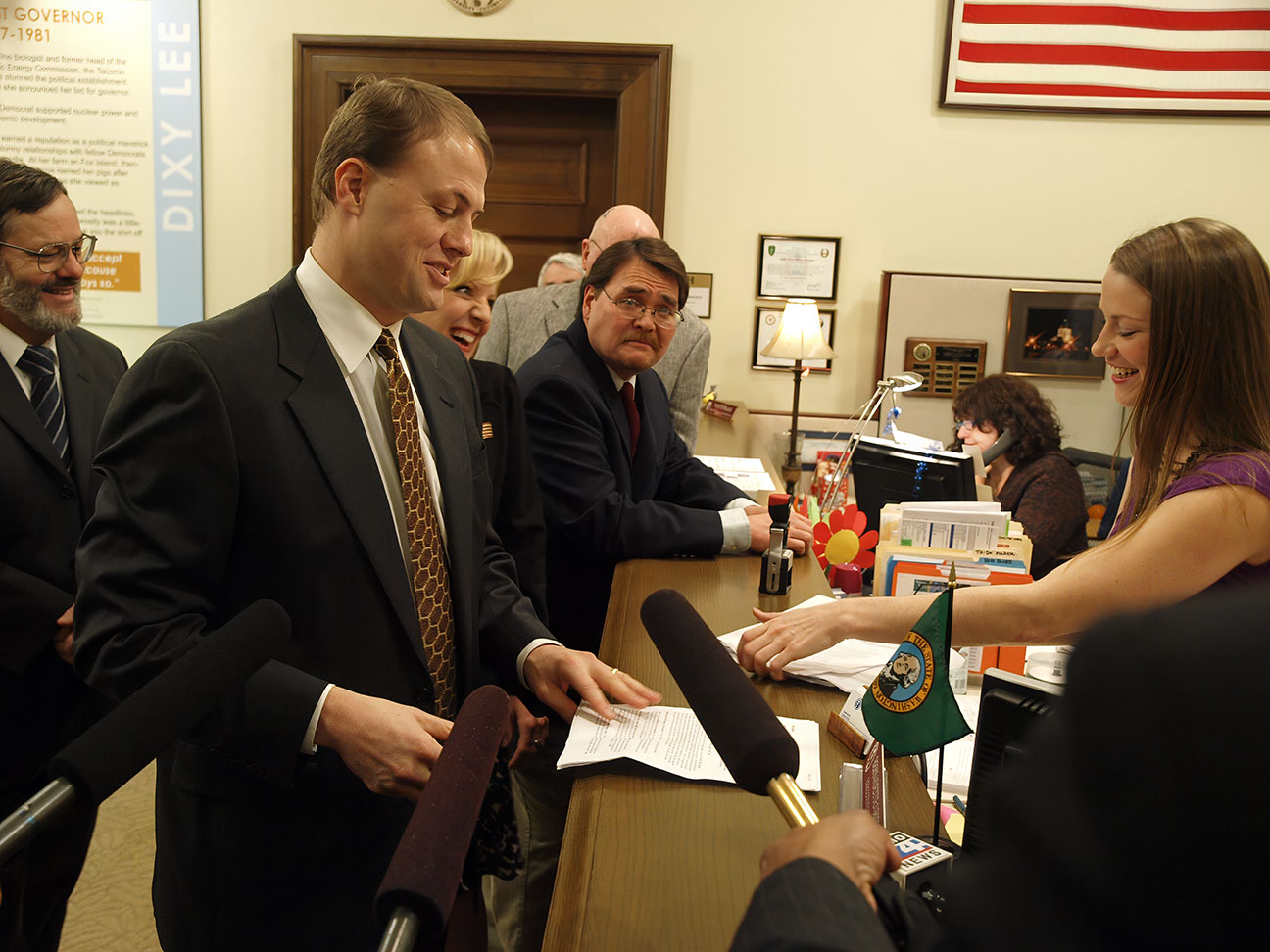
Washington State’s Public Disclosure Commission will investigate allegations that Tim Eyman and his associates failed to timely register a committee for Initiative 517 and failed to timely report contributions and expenditures for the I-517 campaign, its Director of Compliance said this week.

I-517 is an initiative to the Legislature that would:

  • double the length of time that initiative sponsors have to gather signatures for initiatives to the people;
  • dubiously require that cities and counties put initiatives up for a vote even if they exceed the scope of the local initiative power,
  • and unconstitutionally infringe on the First Amendment rights of initiative opponents by attempting to criminalize decline-to-sign activities.

Eyman began quietly working on I-517 a year ago with his associates Roy Ruffino and Eddie Agazarm, who run a petitioning business called “Citizen Solutions” that has repeatedly run afoul of Washington State’s worker protection laws (Eddie and Roy were audited and fined by the Department of Labor & Industries in 2011 for this reason). The trio and their other associates failed to timely register a political committee for I-517 with the Public Disclosure Commission and then failed to timely report the committee’s contributions and expenditures.

This prompted Tacoma activist and fellow Eyman watchdog Sherry Bockwinkel (who used to run a signature gathering firm herself) to file a complaint with the PDC against Eyman and his initiative factory last August.

Up until this week, the complaint had been in limbo. But on Tuesday, the PDC’s Philip Stutzman formally acknowledged that it had been received, and that PDC staff would be conducting an investigation. The case number is 13-027.

Phil’s letter began as follows:

Dear Ms. Bockwinkel:

The Public Disclosure Commission (PDC) received a complaint from you on August 21, 20112, alleging that the Protect Your Right to Vote on Initiatives political committee (PRVI) violated RCW 42.17A.205 by failing to timely register its campaign in support of Initiative 517 to the legislature, and violated RCW 42.17A.235 and RCW 42.17A.240 by failing to file timely, accurate reports of contributions and expenditures. On August 29, 2012, you provided supplemental information relevant to your allegations.

PDC staff will investigate these allegations and notify you of the results when the investigation is complete. All laws cited in this letter can be found on our website, under “Home” and “Laws and Rules.”

It’s a relief to know that the PDC is going to take action and investigate Sherry’s complaint. It should not have taken seven months for them to send a letter saying they’re opening an investigation. Of course, the PDC is a public service, and like most of our state’s other public services, it is underfunded.

(If the PDC had more staff and a bigger budget, it could be more nimble and responsive, and redesign its website to be more accessible and reliable using newer technologies. But that’s a subject for another post).

Tim Eyman may think that he is above the law (and above our state Constitution), but he is not. Citizenship comes with responsibilities as well as rights. If Eyman wishes to exercise his right as a citizen to sponsor initiatives (even unconstitutional ones) then he needs to file his C1-PCs, C4s, and C3s on time.

Eyman has been in business with his initiative factory for over ten years; he should be very familiar with the law by now and be in full compliance all of the time.

But he has not been. His history of delinquent reporting and willful ignorance of our public disclosure laws demonstrates that he does not care about the people’s right to know who is trying to influence their votes during election season or get their signatures during a signature drive.

And speaking of signature drives, the PDC’s decision to act on this complaint comes just a few weeks after after a probe by the Secretary of State’s Elections Division found thousands of apparently fraudulent signatures on I-517 petitions.

The matter has since been turned over to the Washington State Patrol for investigation and potential referral for prosecution.

The fraudulent signatures we know about were submitted by three signature gatherers who also worked on the campaign to qualify I-522, and then turned in to Eyman and his associates, who evidently did not bother to conduct checks of their own petition sheets prior to turning them over to the Elections Division.

We hope that the PDC and State Patrol’s investigations will be thorough and will have repercussions. Tim Eyman and his associates need to be held accountable for the sketchy, shady campaign that they ran last year to qualify I-517. Allowing their lawbreaking to go unpunished would set a bad precedent.

We have a pope! Cardinal Jorge Mario Bergoglio emerges from papal conclave as Francis, first pope from the Americas

To the delight of many Catholics (including this one!) the one hundred and fifteen cardinals who participated in this year’s just-concluded papal conclave in Vatican City have, at long last, given the Church its first pontiff from the New World.

Cardinal Jorge Mario Bergoglio, the archbishop of Buenos Aires, Argentina, has just been introduced to the world as the next Bishop of Rome. He is, as mentioned, the first pope to have been born in the Americas; he is also the first Jesuit pope. (The Society of Jesus, whose members are known as Jesuits, is a well-known Catholic religious order. A number of the United States’ best- known universities were founded by Jesuit priests and remain affiliated with the Society, including Seattle University and Gonzaga University here in Washington State).

Begoglio has taken the name Francisco, or Francis in English.

He is the first pope to take that name.

The new Pope, Francis I, waves from a balcony to crowds assembled in St. Peter's Square. (Photo: Vatican News Service)

The new Pope, Francis I, waves from a balcony to crowds assembled in St. Peter’s Square. (Photo: Vatican News Service)

At a ceremony in Vatican City an hour ago (8:23 PM Vatican Time), Begoglio gave his first public remarks as pontiff. He asked the cheering crowds to pray for the pope emeritus (Benedict) and also for him as he assumes his new responsibilities. He then blessed the assembled multitude before heading back inside St. Peter’s Basilica, flanked by several smiling cardinals.

The Vatican Radio service has begun broadcasting a short biography of the new pope. Here is the transcript:

The man elected to be the 265th Successor of Saint Peter in the conclave, is Cardinal Jorge Mario Bergoglio, S.J., Archbishop of Buenos Aires, Argentina, Ordinary for Eastern-rite faithful in Argentina who lack an Ordinary of their own rite. He was born on 17 December 1936 in Buenos Aires. He was ordained for the Jesuits on 13 December 1969 during his theological studies at the Theological Faculty of San Miguel.

He was novice master in San Miguel, where he also taught theology. He was Provincial for Argentina (1973-1979) and rector of the Philosophical and Theological Faculty of San Miguel (1980-1986). After completing his doctoral dissertation in Germany, he served as a confessor and spiritual director in Córdoba.On 20 May 1992 he was appointed titular Bishop of Auca and Auxiliary of Buenos Aires, receiving episcopal consecration on 27 June. On 3 June 1997 was appointed Coadjutor Archbishop of Buenos Aires and succeeded Cardinal Antonio Quarracino on 28 February 1998. He is also Ordinary for Eastern-rite faithful in Argentina who lack an Ordinary of their own rite.
Adjunct Relator General of the 10th Ordinary General Assembly of the Synod of Bishops, October 2001.

He served as President of the Bishops’ Conference of Argentina from 8 November 2005 until 8 November 2011. Created and proclaimed Cardinal by the Bl. John Paul II in the consistory of 21 February 2001, of the Title of S. Roberto Bellarmino (St. Robert Bellarmine).

The Catholic News Service report on Francis’ election notes that as the leader of the Buenos Aires diocese, he was very much a people’s bishop:

Since 1998, he has been archbishop of Buenos Aires, where his style is low-key and close to the people.

He rides the bus, visits the poor, lives in a simple apartment and cooks his own meals. To many in Buenos Aires, he is known simply as “Father Jorge.”

He also has created new parishes, restructured the administrative offices, led pro-life initiatives and started new pastoral programs, such as a commission for divorcees. He co-presided over the 2001 Synod of Bishops and was elected to the synod council, so he is well-known to the world’s bishops.

Father Jorge is now Francis I – the supreme leader of the Roman Catholic Church. It is fitting that he is is from South America, as that is the continent where the Church has seen the most growth over the last several hundred years.

This decade may well be remembered as the era when South America came of age on the world stage. The selection of Cardinal Bergoglio as the next pontiff is a monumental event for the world and for South America. And another historic event will take place in three and a half years’ time when Rio de Jainero hosts the 2016 Summer Olympics. (No South American city has ever hosted a Games before).

As Francis’ papacy has just begun, it is too soon to know what kind of a pope he will be like. He does, of course, have very conservative views on many issues that progressive activists care about, such as marriage equality or reproductive rights. But in other respects he could be more liberal or progressive than his predecessors. The Catholic Church in Latin America places a stronger emphasis on social justice… and that’s a good thing. This is perhaps the best outcome of the papal conclave that progressive Catholics could have hoped for.

Francis I is two years younger than Benedict was when he became the Church’s leader. His papacy is unlikely to be as long as John Paul II’s, but it promises to be groundbreaking in many ways.

“On behalf of the American people, Michelle and I offer our warm wishes to His Holiness Pope Francis as he ascends to the Chair of Saint Peter and begins his papacy,” President Barack Obama said in a statement released moments ago.

“As a champion of the poor and the most vulnerable among us, he carries forth the message of love and compassion that has inspired the world for more than two thousand years—that in each other we see the face of God. As the first pope from the Americas, his selection also speaks to the strength and vitality of a region that is increasingly shaping our world, and alongside millions of Hispanic Americans, those of us in the United States share the joy of this historic day.”

“Just as I appreciated our work with Pope Benedict XVI, I look forward to working with His Holiness to advance peace, security and dignity for our fellow human beings, regardless of their faith. We join with people around the world in offering our prayers for the Holy Father as he begins the sacred work of leading the Catholic Church in our modern world,” the President concluded.

“The election of Cardinal Jorge Mario Bergoglio, who has taken the name Francis, marks a great milestone in our church,” said Cardinal Timothy Dolan of New York, the current president of the U.S. Conference of Catholic Bishops. “As successor to Peter, our first pope, Pope Francis stands as the figure of unity for all Catholics wherever they reside. The bishops of the United States and the people of our 195 dioceses offer prayers for our new leader and promise allegiance to him.”

“Intense prayer from all around the world surrounded the election of Pope Francis. The bishops of the United States thank God for the guidance of the Holy Spirit and the inspired choice of the College of Cardinals. With joy in our hearts, we declare Ad Multos Annos! (For many years!)”

Archbishop Peter J. Sartain, who was chosen by Pope Francis’ predecessor Benedict XVI a few years ago as the leader of Washington’s largest Roman Catholic diocese (the Archdiocese of Seattle) , said he witnessed the introduction of the new pope on television like many other Catholics in the Pacific Northwest.

“The election of a new pope is an act of faith on the part of the cardinals, because they have placed their hope in God to guide them,” Sartain wrote in a column posted on the Archdiocese’s website.

“For me as an archbishop and for Catholics everywhere, receiving a new pope means that God has been once again faithful to his promise that he would always provide a shepherd for the church, a successor to St. Peter, a bishop of Rome, the first pastor of the universal church.”

“His choice of the name Francis signals that he strives to be a man of humility and love for the poor, and the fact that he asked the hundreds of thousand standing before him to pray for him further underscores his humility.”

“Not even knowing who he would be, I began praying for him weeks ago. I congratulate His Holiness, Pope Francis, on his election to the See of Peter. I promise my obedience and my prayers.”

“As was announced at the Vatican just a few hours ago, we have indeed received news of great joy in the election of Pope Francis.”

Returning to 2/3rds rule an attack on our colleges

Last week when Tim Eyman’s I-1053 was declared unconstitutional there was much cheering and rejoicing across the state of Washington, not least through the halls of Facebook and Twitter. Many of these voices were students at our universities, who have seen more than 1.4 billion cut from our state higher education system since 2009, increased debt, and less accessible forms of financial aid because of the increased use of the State Need Grant and cuts to work study. While work study survived its proposed suspension last year, the current program serves 2/3rds (that number just keeps on popping up doesn’t it?) less students than just a few years ago.

As stated on Crosscut last election season:

For higher education, cuts in state funding are directly linked through the supermajority requirement to shrinking financial aid and skyrocketing tuition that have been so cruel to ordinary families and their children. That’s because when taxes can’t be adjusted under the supermajority regimen, the only alternative is greater reliance on tuition and fees not subject to the chokehold. The result for many young people is doors slammed shut to higher education and for businesses a slender and under-prepared workforce Most agree that these are a very bad, very shortsighted directions.

In fact, recently a poll was released which shows that voters in Washington “overwhelmingly support public higher education and want to see funding for the state’s colleges and universities increased”. Not only do students who have seen universities become less accessible and affordable want to see more money for higher education, put their parents, friends, and families do as well. As Rep. Ross Hunter stated in his legislative update yesterday, “Higher education is one of the areas at greatest risk in our budget process this year”, and this is precisely because the legislature is unwilling to raise revenue to fund higher education and its other commitments.

This is why trying to reinstate the 2/3ds supermajority plan into Senate parliamentary rules is an attack on our Washington colleges and other services that students need to succeed, because, having to beat back a projected 2.3 billion dollar deficit, either tuition will be raised, or services that some students rely on to succeed, like childcare, will be cut. When our new economy needs a highly educated workforce from all backgrounds, this is not the way to adapt.

Students are celebrating the Supreme Court ruling. But unless the legislature intends to use the door that has been opened to genuinely fund education, to fund it more than just in name, to make the words “protect affordability” (because our education system has become anything but affordable) ring true, then our victory is hollow, and we have let Tim Eyman succeed in turning the clock back on our shared society.

Education supporters agree: Restoration of majority rule is an opportunity

People from who care about kids are celebrating Thursday’s Washington Supreme Court ruling striking down the provision at the heart of Tim Eyman’s I-601 clones. Parents, teachers and other advocates for great public schools agree that simply cutting funding from other vital public services and reallocating the money to education – the only option on the table before Thursday’s ruling – will never ensure that we are meeting our paramount duty as a state.

To provide the $1.4 billion needed this biennium to meet the state Supreme Court’s mandate to fund K-12 education, Washington needs to raise more revenue.

The Washington State PTA welcomed the ruling. WSPTA is the largest volunteer organization in the state, with over 140,000 members, both Democrats and Republicans. Members of both parties can see that we have a problem: Washington consistently ranks at the bottom nationally in per pupil spending relative to the income of state residents. From WSPTA:

The association welcomes the state Supreme Court ruling this week that strikes down the two-thirds majority requirement for state revenue increases. This ruling gives policymakers the flexibility they need to make practical and balanced choices for children.

The association also opposes SJR 8205, which seeks to embed the two-thirds requirement into the state constitution.

The inability of legislators to effectively and efficiently deal with the significant underfunding of our K-12 educational system is hurting our children. This fall, our association voted to support additional revenue to pay for children’s education and programs that keep them healthy and safe.

The League of Education Voters was the lead plaintiff in the case and we thank them for fighting in court for our kids. The League is ready for the legislature to seize this opportunity and better fund our schools:

LEV and its partners challenged the law in court because it hamstrung our legislators’ efforts to uphold their paramount duty to invest in the quality public schools our children need to succeed in life.  Our kids suffered at the hands of a small minority of legislators who could veto any new revenue options for education.

This decision comes at the perfect time–our legislators are working right now to develop a plan to fully fund K-12 education. This ruling puts all options on the table. We all want what is best for our students, but year after year, thanks in part to Initiative 1053, the legislature has not provided the funding to pay for basic resources need to educate our students.

The state teachers union has seen its members’ salaries shrivel through years of state budget cuts. Teachers have also seen the impacts of reduced funding in their schools and overcrowded classrooms: school librarians, nurses and counselors have vanished, textbooks are outdated and buildings are under-maintained. From Washington Education Association President Mary Lindquist:

This latest Supreme Court ruling paves the way for the legislature to fully fund K-12 public schools as mandated by the Washington Constitution and the Court’s earlier McCleary decision. We urge the House and the Senate to increase funding for our schools so we can begin to reduce overcrowded class sizes and expand all-day kindergarten. Our students’ future depends on it.

Thursday’s momentous Supreme Court decision created an opportunity for the legislature. But will they use their new power to provide the high-quality education that our kids deserve, or will they be paralyzed by their fear of “the voters’ will?” We need to let our legislators know that we want them to act. Bring back the librarians, fix the leaks, buy the books, and ensure our teachers have the resources they need to help all of our kids realize their full potential in life.

It’s time to update Tim Eyman’s Failure Chart

Now that the Washington State Supreme Court has ruled, at long last, that the main provision of Tim Eyman’s I-601 clones is unconstitutional and void, it’s time for us to update Tim Eyman’s Failure Chart. The Failure Chart is a handy resource that we maintain over at Permanent Defense which shows that most of the initiatives Tim Eyman has sponsored over the years have failed… to get on the ballot, to be approved by voters, or to pass constitutional muster.

We use a simple test to determine whether an Eyman measure is listed as a success or failure. We ask two questions when evaluating each initiative:

  1. Did the initiative pass and survive any legal challenges?
  2. Did the initiative accomplish its main intent as stated by Eyman?

Of the eighteen measures on the chart that Eyman has sponsored and qualified for the ballot, fifteen were classified as failures prior to this morning, with just three classified as successes. Now that we have the Supreme Court’s ruling in hand, we can change the classification of I-1053 (2010) and I-1185 (2012) to FAILURE, leaving I-900 (2005; performance audits) as Eyman’s only success.

Here is a precise breakdown of the initiatives so you can see for yourself why we classify seventeen of the eighteen measures as failures:

  • Failed to qualify for the ballot (five): I-267 (2002); I-807 (2003); I-864 (2004); I-917 (2006); Referendum 65 (2006)
  • Defeated by voters (five): I-745 (2000); I-892 (2004); I-985 (2008); I-1033 (2009); I-1125 (2011)
  • Voided completely by the courts (three): I-695 (1999); I-722 (2000); I-747 (2001)
  • Voided partially by the courts (four): I-776 (2002); I-960 (2007); I-1053 (2010); I-1185 (2012)
  • Remains on the books, never challenged (one): I-900 (2005)

It is not an accident that so many of Tim Eyman’s initiatives have been successfully challenged in court. We rarely review an Eyman initiative that we wouldn’t describe as poorly written or unconstitutional. And that’s because Eyman is terrible at writing law. He doesn’t even come up with his own ideas… instead, he recycles schemes cooked up by right wing think tanks and prominent Republicans.

I-807/I-960/I-1053/I-1185 are based on Linda Smith’s I-601, for instance. Eyman got the idea to do I-695 from Virginia’s Jim Gilmore, and he imported I-1033 from Colorado. Ironically, it was Eyman’s No. 1 all-time wealthy benefactor, Michael Dunmire, who convinced him to sponsor the initiative that now stands as his only success: I-900.(Dunmire also put up the money to get I-900 on the ballot).

Writing laws that work well, are compatible with our plan of government, and can withstand the scrutiny of the judicial system is very difficult to do. Care, thought, precision, and patience are required.

That is why the legislative process is so slow and deliberative in nature. Bills going through the Legislature are subject to public hearings in multiple committees and are frequently amended (or even replaced in their entirety) prior to receiving a vote on the floor. All lawmakers have legislative assistants to help them do their jobs, and professional staff to advise and support their work.

Most people who run for Legislature do so because they genuinely want to make Washington a better place to live, work, worship, and play. But Tim Eyman, who has become the state’s most prolific unelected lawmaker, has never shown any interest in governing. He prefers to make trouble for others rather than dedicating himself to the betterment of the lives of his fellow citizens.

We have never seen an Eyman initiative aimed at ending homelessness or cleaning up Puget Sound. And we probably never will, because putting people and planet ahead of profit is sadly not part of Tim Eyman’s values system.

Governor Jay Inslee, advocates thrilled with today’s landmark Supreme Court decision

The Supreme Court’s landmark ruling in LEV v. State has now been up on the World Wide Web for a couple of hours, and we’ve been on the receiving end of a number of statements and press releases commenting on the decision. We’d like to share some of what we’re hearing with you.

First, Governor Jay Inslee released a very enthusiastic and thoughtful statement that we’re going to run in full, because it rocks:

The state Supreme Court did the right thing today in ruling that a supermajority requirement for ordinary legislation would alter our system of government. The supermajority requirement gave a legislative minority the power to squelch ideas even when those ideas had majority support. That is inconsistent with our fundamental form of representative democracy.

Majority rule is a foundation of our system of government. Alexander Hamilton understood this and warned that giving ‘the minority a negative upon the majority’ would cause ‘tedious delays; continual negotiation and intrigue; contemptible compromises of the public good.’ James Madison understood this. And the framers of Washington’s Constitution had vigorous debate on the issue and were deliberate in embedding the principle of majority rule in our constitution.

Those principles have served the people of Washington well, and I’m heartened that the state Supreme Court acted today to protect our Constitution.

Indeed it did. Well said, Governor!

Representative Chris Reykdahl, one of the legislators who participated in the legal challenge, characterized the decision as historic.

“Today’s decision from the Washington State Supreme Court may very well be the most significant decision in our state’s history. Today the court made clear that our Constitution cannot be amended by the initiative process. This profound ruling means that profiteering initiative writers will not be able to take away protected freedoms and rights guaranteed to the people or the Legislature.”

“We must move forward now with caution – carefully and thoughtfully crafting an equitable tax system will take time and sincere commitment from legislators and citizens,” he added. “The restructuring process will take years, but we can and should begin this session by establishing a set of bipartisan taxing principles – fairness, stability, adequacy, and transparency are four key principles that will become the foundation for future transformation.”

The leaders of the two lead plaintiffs, the Washington Education Association and the League of Education Voters, also cheered the ruling in a joint statement.

“This ruling is a huge win for kids and schools,” said Chris Korsmo, CEO of the League of Education Voters.

“Washington schools need to be fully funded in order to ensure that all kids reach their potential. This ruling, combined with the recent McCleary decision, will help ensure that our kids have all the resources they need to get an excellent education.”

“This latest Supreme Court ruling paves the way for the legislature to fully fund K-12 public schools as mandated by the Washington Constitution and the Court’s earlier McCleary decision,” agreed Mary Lindquist, President of the Washington Education Association, which represents thousands of teachers.

“We urge the House and the Senate to increase funding for our schools so we can begin to reduce overcrowded class sizes and expand all-day kindergarten. Our students’ future depends on it.”

“This [decision] squares with Article 2, Section  22 of the State Constitution, which requires a majority of members of each house voting yea for the passage of a bill,” noted Washington State Labor Council President Jeff Johnson. “The Constitution does not differentiate between policy and revenue bills.”

“This decision ends the tyranny of the minority that the Washington State Legislature has endured for the last several years. Under I-1053 [and now I-1185] all it took were seventeen state senators to block any revenue measure from passing and indeed this has happened almost all the time.”

It has been wonderful to see so many activists celebrating and responding to the ruling on social media. We have much to be grateful for today. Six of our nine Supreme Court justices took a very brave stand and upheld our Constitution in the face of pressure from powerful business interests, editorial boards, and our state’s conservative political apparatus. They deserve our thanks.

  • RSS Recent entries from the Permanent Defense Media Center